multiplex wormhole
Explore Optimization Parameters
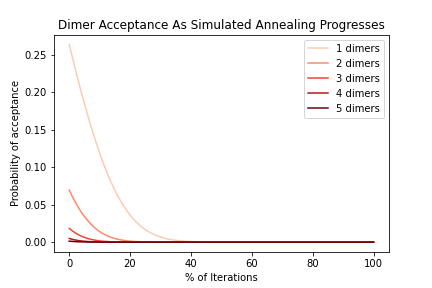
The optimization process relies on a simulated annealing algorithm which allows earlier iterations to accept increases in dimer load to overcome local optima. The probability of accepting increased dimer load is defined by a variety of parameters, which can be explored with this function.
See here for optimization process details included simulated annealing algorithm parameterization.
Usage
The plot_ASA_temps.py function is setup to accept two different sets of inputs: 1) Provided simulated annealing parameters, or 2) Provided datasets used to calculate simulated annealing parameters (the default used in optimize_multiplex.py). Inputs are shown for both options. Provided datasets are ignored if MAX_DIMER and MIN_DIMER are provided.
Command line syntax
# usage:
mw-plot-simannel [-h] -o OUTPATH [-f PRIMER_FASTA] [-d DIMER_SUMS]
                        [-t DIMER_TABLE] [-n NLOCI] [-k KEEPLIST] [-e SEED]
                        [-m MIN_DIMERS] [-a MAX_DIMERS] [-r DECAY_RATE]
                        [-i TEMP_INIT] [-j TEMP_FINAL] [-b BURNIN]
                        [-p PROB_ADJ] [-g]

# example with user-defined parameters:
mw-plot-simanneal -o OUTPATH [-m MIN_DIMERS] [-a MAX_DIMERS] [-r DECAY_RATE] [-i TEMP_INIT] [-f TEMP_FINAL] [-p PROB_ADJ]

# example for calculating and visualizing parameters from data:
mw-plot-simanneal -o OUTPATH [-f PRIMER_FASTA] [-d DIMER_SUMS] [-t DIMER_TABLE] [-n NLOCI] [-k KEEPLIST] [-b BURNIN] [-g]

# example using a previous optimization run to calculate parameters:
mw-plot-simanneal -o OUTPATH [-f PRIMER_FASTA] [-d DIMER_SUMS] [-t DIMER_TABLE] [-n NLOCI] [-k KEEPLIST]
Python syntax
import multiplex_wormhole as mw
mw.plotASAtemps(OUTPATH, PRIMER_FASTA, DIMER_SUMS, DIMER_TABLE, N_LOCI, KEEPLIST=None, ...)
Arguments
- OUTPATH (-o) : Prefix for output files, including directory path.
- PRIMER_FASTA (-f) : FASTA filepath containing primer sequences to test. Important: PrimerIDs in this file must match primer pair IDs in DIMER_SUMS and DIMER_TABLE! (Default: None)
- DIMER_SUMS (-d) : Filepath to CSV containing dimer loads per primer pair. (Default: None)
- DIMER_TABLE (-t) : Filepath to CSV containing pairwise primer dimer loads. (Default: None)
- N_LOCI (-n) : Target panel size (includes keeplist loci), i.e. the number of unique targets and primer pairs in the optimized multiplex. (Default: None)
- KEEPLIST (-k) : Filepath to FASTA file containing primer sequences that are required to be included in final primer set. (Default: None)
- SEED (-e) : CSV to primer set used as initial loci, in format of multiplex_wormhole output *_primers.csv. This option overrides N_LOCI, so the number of loci in the SEED set will be the final number of loci in the primer set. (Default: None)
- MIN_DIMER (-m) : Minimum ‘bad’ dimer change expected going from one iteration to the next. Generally MIN_DIMER=1. (Default: None - calculated from data)
- MAX_DIMER (-a) : Maximum ‘bad’ dimer change expected moving from one iteration to the next. (Default: None - calculate from data)
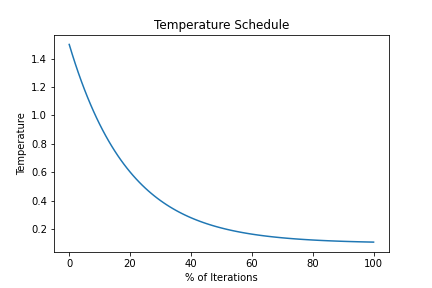
- DECAY_RATE (-r) : Base value used in decay function for temperature. Values close to 1 lead to slow temperature decay while decreasing values lead to more rapid temperature decay. (Default: 0.95, limit: 0-1)
- T_INIT (-i) : Initial temperature where simulated annealing starts. If not provided, this value will be calculated from changes in dimer load. (Default: None- set adaptively)
Adaptively calculated as
MIN_DIMER + DIMER_ADJ * (MAX_DIMER - MIN_DIMER) - T_FINAL (-j) : Final temperature where simulated annealing ends. If not provided, this value will be calculated from changes in dimer load. (Default: 0.1)
- BURNIN (-b) : Number of ‘bad’ swaps used to sample changes in dimer loads. (Default: 100)
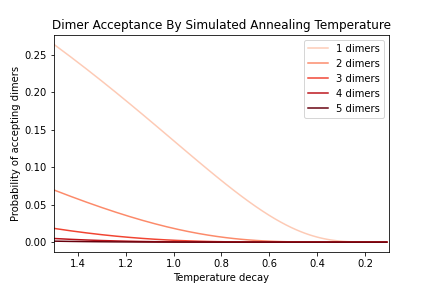
- PROB_ADJ (-p) : Multiplier to adjust dimer acceptance probability, where 1=no adjustment and higher values reduce dimer acceptance probability. (Default: 2)
The probability of accepting an increase in dimer load follows
e^(-PROB_ADJ*cost / temperature) - deltaG (-g) : Optimize for total dimer tally (False) or maximum average deltaG among dimers (True)? [Default: False]
Outputs
Probabilities reflect default parameters, although the initial (higher) temperature will vary depending on the dataset.
OUTPATH_TemperatureSchedule.png
OUTPATH_DimerAcceptanceByTemp.png
OUTPATH_DimerAcceptanceByIteration.png